
A Complete Guide for Couples in Pakistan
Choosing a wedding venue is one of the most important decisions when planning a wedding. The venue sets the atmosphere for the celebration, influences the overall budget, and determines how comfortable guests will feel throughout the event. Whether you are planning an intimate Nikah ceremony, a traditional Mehndi, a grand Barat, or an elegant Walima reception, selecting the right location can make the entire experience more enjoyable.
However, with so many options available, finding the perfect wedding venue is not always easy. From banquet halls and wedding marquees to luxury farmhouses and outdoor event spaces, every venue offers different facilities, packages, and experiences.
So, how do you select the best wedding venue?
The best approach is to compare venues based on your guest count, budget, location, event requirements, available facilities, and overall convenience. Rather than choosing a venue simply because it looks beautiful, focus on finding a space that meets your practical needs and matches your wedding vision.
In this guide, we will explore the most important factors to consider when selecting a wedding venue and explain how to make a confident decision.
1. Start by Defining Your Wedding Requirements
Before exploring wedding venues, take some time to understand what you actually need. Every wedding is different, and the ideal venue for a small family gathering may not be suitable for a large wedding reception.
Start by considering the type of function you are organising. For example:
- Nikah Ceremony: A peaceful and elegant setting with comfortable seating for family and guests.
- Mehndi Function: A lively space with room for colourful décor, entertainment, performances, and guest interaction.
- Barat Ceremony: A spacious venue with a suitable stage, entrance arrangements, and seating capacity for a larger gathering.
- Walima Reception: A sophisticated and well-organised venue with comfortable seating, quality catering, and an elegant atmosphere.
Also, decide whether you prefer an indoor wedding venue, an outdoor location, or a combination of both.
Having a clear idea of your wedding style, expected guests, and essential requirements will make it easier to shortlist suitable options.
2. Set a Realistic Wedding Venue Budget
Budget is one of the most important factors when selecting a wedding venue. A venue may look affordable at first, but additional charges can significantly increase the overall cost.
Instead of comparing venues only by their rental price or per-head package, calculate the complete cost of hosting your wedding there.
Ask the management for a detailed quotation covering:
- Venue rental or booking charges
- Catering and food packages
- Stage decoration and floral arrangements
- Furniture and seating arrangements
- Lighting and sound system
- Generator or power backup charges
- Service charges and applicable taxes
- Parking and valet services, if applicable
- Additional hours or overtime charges
- Cleaning and other service fees
For example, a banquet hall offering a lower per-head rate may not include decoration, while another venue may provide a more complete package.
The key is to compare the total cost of similar services rather than relying on the advertised starting price.
It is also wise to keep some flexibility in your budget for unexpected requirements, additional guests, or last-minute arrangements.
3. Choose a Venue That Matches Your Guest Count
Guest capacity directly affects your wedding venue selection. Booking a venue that is too small can make the event uncomfortable, while an excessively large space may feel empty and increase unnecessary expenses.
Before finalising a venue, prepare an estimated guest list and discuss the seating arrangements with the management.
Consider the following:
- Number of invited guests
- Seating capacity for families
- Space required for the wedding stage
- Buffet and dining arrangements
- Entrance and exit pathways
- Photography and entertainment areas
- Space for elderly guests and families with children
One important detail is to distinguish between the venue’s maximum capacity and its comfortable seated capacity.
A hall advertised for 500 guests may accommodate fewer people comfortably once the stage, dining area, walkways, and other arrangements are included.
Always request a seating layout or floor plan to understand how the space will look during your actual wedding function.
4. Consider the Venue Location and Accessibility
A beautiful wedding venue is not necessarily the best choice if guests struggle to reach it.
Location plays a major role in the overall guest experience, particularly when family members are travelling from different parts of the city.
When comparing wedding venues, consider:
- Distance from major residential areas
- Road connectivity and traffic conditions
- Availability of parking
- Accessibility for elderly and disabled guests
- Clear entrance and exit routes
- Nearby accommodation for out-of-city guests
- Availability of transport and ride-hailing services
If you are planning a wedding in Lahore, consider how convenient the venue is for guests travelling from areas such as DHA, Gulberg, Model Town, Johar Town, Bahria Town, or other parts of the city.
Do not judge accessibility by distance alone. Check the expected travel time during the hours when your guests will arrive.
You can use Google Maps to compare routes and travel options before making your decision.
5. Understand Different Types of Wedding Venues
Not every wedding venue offers the same atmosphere or facilities. Understanding the differences between available venue types can help you choose an option that suits your event.
Banquet Halls
Banquet halls are a popular choice for formal wedding celebrations, receptions, and indoor functions. They generally provide a structured event environment with dedicated seating and dining areas.
Best suited for: Barat, Walima, receptions, and formal wedding gatherings.
Before booking, check the hall’s seating capacity, air conditioning, stage arrangements, washrooms, parking, and power backup.
Explore banquet halls on VenueHub to compare available options.
Wedding Marquees
Wedding marquees are suitable for larger gatherings and celebrations that require spacious event layouts. They can offer flexibility in seating, stage arrangements, and decoration themes.
Best suited for: Large Barat functions, wedding receptions, and grand family celebrations.
Check the flooring, ventilation, heating or cooling arrangements, lighting, washrooms, and parking facilities before finalising a marquee.
Discover available marquees on VenueHub.
Farmhouse Wedding Venues
Farmhouses provide a more private and open setting for wedding celebrations. Their outdoor spaces can offer flexibility for customised decoration, seating arrangements, and different event themes.
Best suited for: Outdoor weddings, intimate celebrations, private gatherings, and customised wedding events.
However, always check whether the property has sufficient covered space, washrooms, parking, power backup, and a suitable alternative in case of bad weather.
You can explore farmhouses for weddings and events to discover different options.
Outdoor Wedding Venues
Outdoor venues offer a natural setting that can create a beautiful atmosphere for wedding photography and celebrations.
Gardens, lawns, and open event spaces can be especially appealing for daytime or evening functions.
Before choosing an outdoor location, confirm the availability of covered seating, suitable lighting, weather protection, and indoor backup arrangements.
The right venue type ultimately depends on your wedding style, guest count, budget, and preferred atmosphere.
6. Check Facilities and Guest Comfort
A wedding venue should offer more than an attractive entrance and beautifully decorated stage. Practical facilities are equally important for ensuring a comfortable experience.
During your venue visit, pay attention to the following facilities:
Essential venue facilities:
- Clean and accessible washrooms
- Comfortable seating arrangements
- Air conditioning or heating, depending on the season
- Generator or alternative power supply
- Proper lighting and sound equipment
- Bridal or family preparation room, if required
- Separate dining arrangements, if needed
- Accessible entrances and pathways
- Adequate parking space
- Drinking water facilities
Also, check whether the venue has enough staff to manage guest entry, food service, cleaning, and general event coordination.
These details may seem minor during the booking process, but they can have a significant impact on the wedding day.
7. Evaluate Catering and Food Quality
Food is an important part of wedding celebrations, particularly in Pakistan, where guests often have high expectations regarding menu variety and food service.
A venue may offer an attractive package, but you should never finalise catering arrangements without understanding the menu and service quality.
Ask the management about:
- Available menu options
- Food quality and preparation arrangements
- Per-head catering charges
- Number of dishes included
- Serving staff and dining arrangements
- Mineral water and beverage options
- Special dietary requirements
- Additional guest charges
- Food serving and replenishment timings
If possible, arrange a food tasting before confirming the catering package.
You should also ask who is responsible for food preparation, storage, serving, and cleanliness.
For weddings in Punjab, the Punjab Food Authority’s official food business SOPs include guidance specifically for marriage halls and catering-related operations. You can use this as a reference when discussing food hygiene arrangements with your venue or caterer.
8. Review Decoration Options and Vendor Policies
Wedding decoration plays a major role in creating the desired atmosphere. From floral entrances and elegant stages to customised lighting and table arrangements, every detail contributes to the overall presentation.
However, not every venue allows the same decoration arrangements.
Before booking, ask:
- Does the venue provide in-house decoration?
- Can you hire an external wedding decorator?
- Are stage decoration and lighting included?
- Can the venue accommodate your preferred theme?
- Are there additional installation or setup charges?
- What time can decorators access the property?
- Are there restrictions on hanging installations or other decorative elements?
If you are planning Mehndi, Barat, and Walima functions, discuss whether the venue can accommodate different themes and layouts.
A good venue should allow you to create the desired atmosphere without compromising guest comfort, safety, or practical arrangements.
9. Check Weather Arrangements for Outdoor Weddings
Outdoor wedding venues can look stunning, but weather conditions should always be considered before booking.
Rain, strong winds, extreme heat, and unexpected temperature changes can affect an outdoor event.
Ask the venue management about:
- Indoor backup arrangements
- Covered seating areas
- Tent or canopy options
- Cooling and heating facilities
- Proper drainage
- Weather-resistant flooring
- Backup lighting and electricity
For events planned outdoors, check the Pakistan Meteorological Department’s official forecasts and alerts closer to your wedding date.
Remember that checking the forecast is not enough. A proper backup plan should already be agreed upon with the venue management.
10. Visit the Venue Before Making a Final Decision
Online pictures and videos are useful for exploring wedding venues, but they cannot replace an actual site visit.
A physical visit allows you to evaluate the venue’s condition, layout, facilities, and overall suitability.
During your visit, try to imagine how the space will look when your guests arrive.
Check the entrance, stage position, dining area, washrooms, parking, lighting, and overall cleanliness.
If possible, visit during a similar time of day to your planned function. This will help you understand the lighting, surroundings, and practical arrangements more clearly.
Take photographs, ask questions, and compare your observations with the information provided online.
Never make a final decision based only on attractive promotional pictures.
11. Understand Booking Terms and Conditions
Before paying a booking deposit, carefully review the venue’s booking agreement.
A professional booking arrangement should clearly explain what both parties have agreed upon.
Make sure the following details are confirmed in writing:
- Wedding date and event timings
- Total booking charges
- Number of guests included
- Catering and decoration arrangements
- Services included in the package
- Payment schedule
- Deposit and refund policy
- Cancellation or postponement conditions
- Overtime charges
- Responsibilities of the venue management
Do not rely entirely on verbal promises. Written confirmation helps prevent misunderstandings and gives you a clear record of the agreed arrangements.
Also, confirm the venue’s availability for your preferred date before making any payment.
12. Compare Shortlisted Venues Before Booking
Once you have shortlisted a few wedding venues, compare them using the same selection criteria.
Instead of choosing the first attractive option, create a simple comparison table.
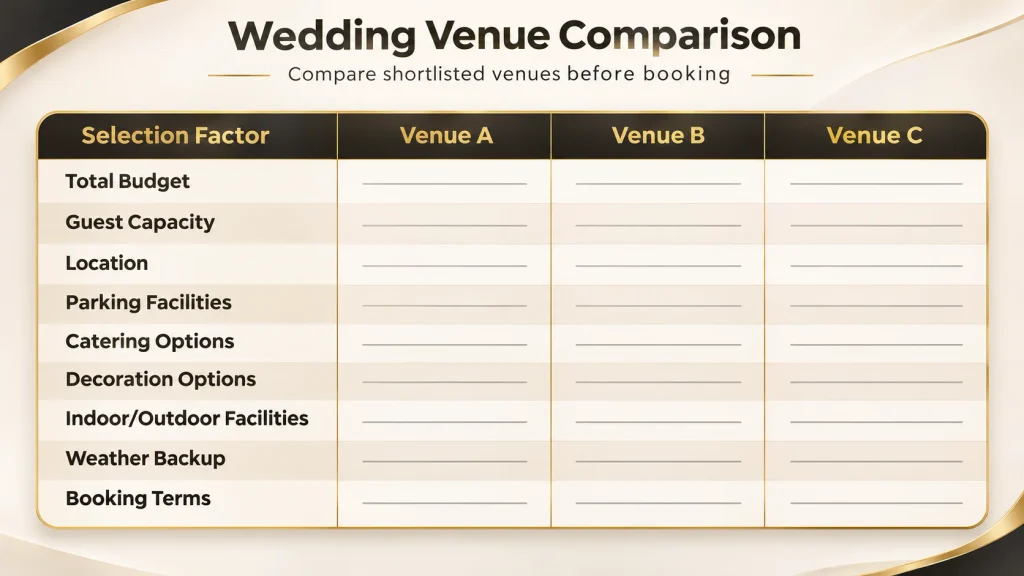
You can also rate each venue from 1 to 5 for every category.
Give greater importance to the factors that matter most to your event. For example, if you are planning a large Barat, guest capacity and parking may be more important than decorative features.
This approach makes the selection process more organised and helps you choose a venue based on actual requirements rather than appearance alone.
Find the Right Wedding Venue with VenueHub
Finding a wedding venue that matches your expectations, guest requirements, and budget does not have to be complicated.
With VenueHub, you can explore different event spaces, compare available venue options, and discover facilities for your upcoming wedding celebration.
Whether you are looking for a spacious farmhouse, an elegant banquet hall, or a grand wedding marquee, VenueHub brings different venue options together to simplify your search.
You can also explore related event services, including decoration, catering, and event planning support.
If you are planning a wedding in Lahore, start by exploring wedding and event venues on VenueHub. You can also review its event planning services to discuss your preferred date, guest count, location, and budget.
The right venue is not necessarily the most expensive or luxurious one. It is the place that brings together convenience, comfort, affordability, and the atmosphere you want for your special celebration.
Frequently Asked Questions About Selecting a Wedding Venue
1. What should I consider first when selecting a wedding venue?
Start with your wedding date, estimated guest count, overall budget, and preferred location. These four factors will help you eliminate unsuitable options and create a practical shortlist.
2. How early should I book a wedding venue?
It is advisable to start exploring venues as soon as your wedding date and approximate guest count are decided. Popular venues and weekend dates may have limited availability, so early enquiries give you more time to compare options.
3. Which is better for a wedding: a banquet hall, marquee, or farmhouse?
It depends on your wedding requirements. Banquet halls are suitable for formal indoor functions, marquees offer flexible space for larger gatherings, and farmhouses provide a more private and open setting. Compare their facilities, costs, and backup arrangements before deciding.
4. How do I choose the right wedding venue capacity?
Prepare an estimated guest list and ask the venue for its comfortable seated capacity. Make sure the layout includes enough room for the stage, dining arrangements, walkways, and other event requirements.
5. What questions should I ask before booking a wedding venue?
Ask about total charges, available dates, guest capacity, catering, decoration, parking, power backup, overtime fees, cancellation policies, and the services included in the package. Request written confirmation of all important terms.
6. Should I visit a wedding venue before booking it?
Yes. A physical visit helps you assess the actual space, cleanliness, seating arrangements, parking, washrooms, and facilities. It also allows you to discuss your event requirements directly with the management.
7. How can I find the best wedding venue in Lahore?
Start by identifying your preferred area and estimated guest count. Then compare banquet halls, marquees, and farmhouses based on location, budget, facilities, and availability. VenueHub can help you explore different wedding venue options in Lahore.
Final Thoughts
Selecting the best wedding venue requires careful planning, research, and comparison. A beautiful location is important, but guest comfort, accessibility, budget, catering, facilities, and reliable booking terms should always be part of your decision.
Take your time to explore different options, visit shortlisted venues, and ask the right questions before making a commitment.
With the right planning and a suitable venue, you can create a wedding celebration that reflects your vision and gives your guests a comfortable and memorable experience.